🙂 Hi there! Here are two lines from my poem – ‘Wicked Winter Tree‘:
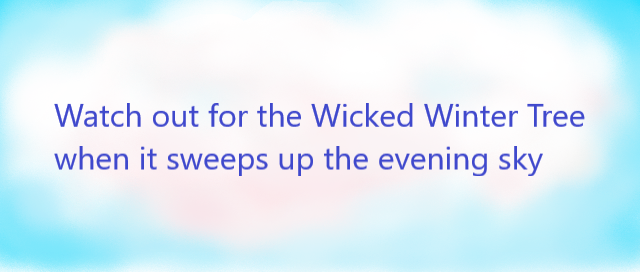
Extend and develop!
If you’re a teacher, parent or child carer, you could offer this as a starting point for a spooky, mysterious, wintry poem with your young poets, either together or individually.
Discuss bare, December trees, their twisty twigs and their bare, stretching branches, black against dark or flaming twilight skies. What images do they bring to mind? Skeletons, gnarled fingers, bent, wizened creatures? Or elegant dancers, graceful arms or figures, perhaps? Imagine together the atmosphere that sky, weather and trees might evoke together. Who’s seen a sunset lately and can describe it? Who’s been out on a misty, murky evening, or a bitter, frosty one? Now envisage and discuss how the tree might seem to be sweeping up that sky.

Explore
Re-reading the two lines, discuss development possibilities together, for a fascinating and fulfilling session. Is the tree re-imagined as a series of different creatures? Or does the writer lead the reader up close, perhaps inside a hollow or up through the branches? Does the wind stir, adding spooky murmurings and flutterings, or does a frost enwrap its fine, tangled mesh of twiglets, producing a dewy veil?
Choose your tone
If some prefer to omit the word ‘wicked’, that’s fine. Others, though, may choose to pursue it, with Halloween figures or fairytales in mind.
Perhaps, in a later verse, the tree is lit with merry, colourful lanterns for Christmas, leaving the reader in a warm, welcoming glow. Or maybe, by contrast, they are led deep into a moonlit, nature-scented wood – a secret winter world? For a shorter, simpler activity, just invite children to re-write those two lines in other ways, using varying vocabulary.
Who can ‘be’ a winter tree? Enact a whole-class Christmas forest, perhaps with a sinking sun, rising moon, twinkling stars and the odd foraging woodland creature!
Rhyme?
Sky might be rhymed with spy, high, fly, why, shy, die, try, pie, I, deny, or other words, though there is no need for any rhymes. Encourage children to listen to the rhythm, and try to sustain it in their added lines. Rhythm can be more expressive and appealing than rhyme, and less restricting.

Finally, revisit your enacted scene with readings from the children’s completed poems. Individual poems can also be illustrated.
Enjoy!
Kate
By the way…
My new book, Squeak! Squawk! Roar! Amazing Animal Poems, will be out on 9th January with Otter-Barry Books. (8.99). Age 6+ . Available from Amazon and all good bookstores, or your local library – if you still have one!

For more poetry teaching and prompting ideas, have a browse through the Archives. More soon!
 Kate Williams
Leave a comment